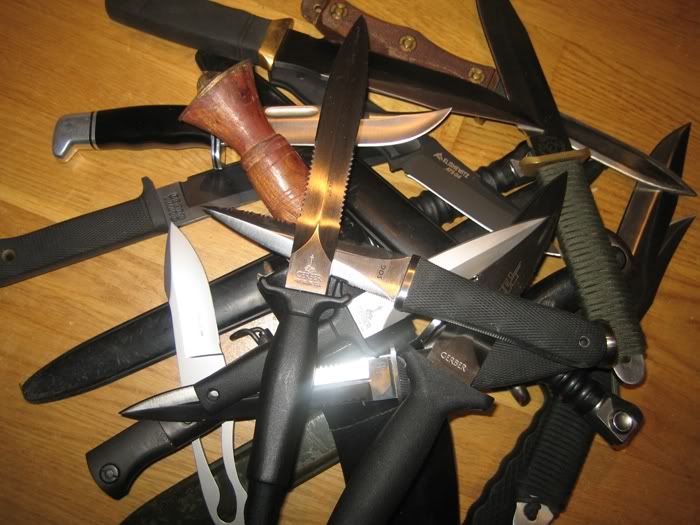
 Knives are everywhere. I have spent a lot of time searching out realistic defenses for knife attacks. Bladed weapons are everywhere. They fascinate and terrify me at the same time. Not long ago, one of J.C's posts over at Bujutsu: the Path got me thinking in reverse. I always stress that any time you use a weapon, it should be an extension of your empty hand techniques. This commonality of techniques reduces the chances of getting tripped up when adding a weapon to the equation. J.C. mentioned that the actions or motions or concepts behind certain weapons techniques helped him develop his empty hand techniques. He learned from the instrument itself versus my insistence of making the instrument bend to my empty hand concepts. It's all a matter of perspective, but it gave me pause.
I have, and will, discuss knife defense in the future. Being attacked with a knife attack is, in my opinion, the most dangerous and the most likely form of violence that the average law abiding person will face.
Some people may be tempted to arm themselves with knives in order to defend themselves. There are several issues to consider. There are four topics that need to be considered.
#1. It is illegal in many countries, states and provinces.
#2. The very fact that someone arms themselves can cause a false sense of security. The person may be tempted to engage in a behaviour that they would not normally partake in. They might get into a situation that they would normally walk away from due to false confidence in their weapon or blade.
#3. Unless a person is trained in the use and the retention of a weapon, the very real risk of the weapon being taken from them by their attacker and then being used on them exists.
#4. Finally, a point that is often overlooked. Knives are a poor choice for self defense. For self defense.
I'm the first to stress how deadly dangerous knives are. An attack can be fatal with a small slash or a shallow puncture. Having said that, these results most often occur some time after the attack.
Most people who are attacked with a knife do not realize that they have been stabbed or cut until after the event. Most often, they think they have been punched or slapped until they see either the blade or the blood. The initial ability to fight back is normally still intact. There are exceptions, of course, but more often than not, the effects or the attack do not incapacitate the victim until some time later.
This is the reason for stressing the point that knives are a poor choice for self defense. The use of a knife to try to overpower or stop an attacker from attacking is unrealistic. Chances are, a motivated attacker will complete their assault on you before the results of your knife attack/defense are realized. If your goal is to protect yourself and get away safely from a violent assault, knives are not your best option.


